
The calories in rice are widely misunderstood, and it is the one food that gets unfairly demonized in Indian fitness culture.
The moment someone decides to lose weight, the first thing they often cut out is rice, replacing it with multiple rotis or expensive imported quinoa. Three weeks later, craving their staple comfort meal, they binge on biryani and assume they lack willpower.
The truth is simple: Rice does not make you fat. Eating unmeasured portions in a caloric surplus makes you fat.
Here is the exact breakdown of calories in rice, how raw weights convert to cooked volumes, how white compares to brown and basmati, and how to eat rice while losing body fat.
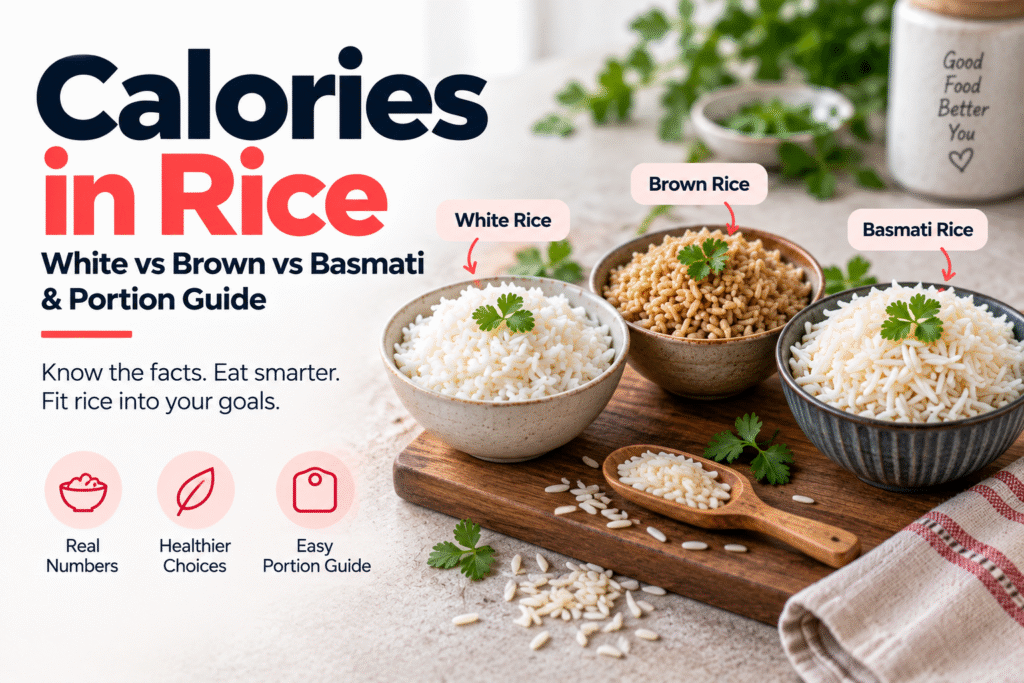
Raw vs Cooked Rice: The Critical Distinction
The most common mistake when tracking rice calories is confusing raw (uncooked) weight with cooked weight.
Rice absorbs roughly 2.5 to 3 times its weight in water during cooking. Water contains zero calories, which means 100 grams of cooked rice contains significantly fewer calories than 100 grams of dry, raw grains.
“`100g Raw Dry Rice (~350–360 kcal) + 200ml Water = ~280–300g Cooked Rice (~350–360 kcal)“`
Therefore, 100g of Cooked Rice has only ~125–130 kcal.
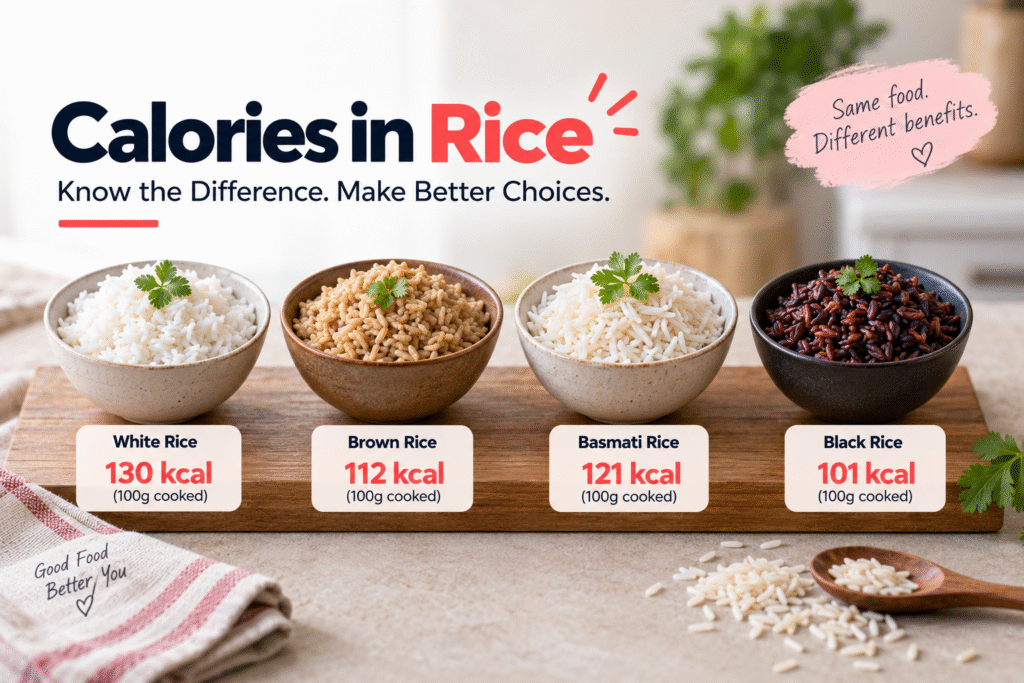
Calories in Rice by Type (Per 100g Cooked)
| Rice Variety | Calories (100g cooked) | Carbohydrates (g) | Protein (g) | Fat (g) | Fiber (g) | Glycemic Index (GI) |
| White Basmati Rice | 121 kcal | 26.0g | 3.0g | 0.4g | 0.6g | 50–58 (Medium-Low) |
| Standard White Rice (Sona Masoori) | 130 kcal | 28.2g | 2.7g | 0.3g | 0.4g | 70–72 (High) |
| Brown Rice | 112 kcal | 23.5g | 2.6g | 0.9g | 1.8g | 55–60 (Medium) |
| Parboiled / Usna Rice | 123 kcal | 26.5g | 2.8g | 0.4g | 1.2g | 50–55 (Low-Medium) |
| Black / Wild Rice | 101 kcal | 21.3g | 4.0g | 0.3g | 2.2g | 45 (Low) |
Portion Guide: Calories in Rice for Everyday Indian Servings
Most people do not weigh food on a scale at lunch. Here is what common Indian serving sizes translate to in cooked white rice:
- 1 Standard Indian Katori (approx. 100g – 120g cooked): ~130 – 155 kcal
- 1 Standard Measuring Cup (approx. 150g – 160g cooked): ~190 – 205 kcal
- 1 Medium Restaurant Rice Bowl (approx. 200g cooked): ~260 kcal
- 1 Full Dinner Plate of Rice (approx. 300g – 350g cooked): ~390 – 455 kcal
The Takeaway: When people say ‘rice makes me gain weight,’ the calories in rice are rarely the real problem. They are usually eating a large 350g plate (450 calories) mixed with oily curry (300 calories) without realizing the total load.
Calories in Rice: White, Brown & Basmati (Without Giving Up Your Favorite Staple)
Wondering how many calories are in rice? This guide breaks down calories in white, brown, and basmati rice, raw vs cooked conversions, and easy portion sizes like katori, cup, and plate. Learn how to enjoy rice while still losing fat, without guessing your portions.
Also Read suggested Articles :
Personal Trainer Cost in Bengaluru
Meet Kyra the AI Health Companion
Best Indian Weight Loss Diet Plan
White Rice vs Brown Rice: Does Brown Rice Actually Help You Lose Weight Faster?
The calorie difference between cooked brown rice (112 kcal/100g) and cooked white basmati rice (121 kcal/100g) is virtually negligible—less than 10 calories per serving.
- Fiber & Micronutrients: Brown rice retains the bran and germ, giving it slightly more magnesium, phosphorus, and fiber (1.8g vs 0.6g per 100g).
- Digestibility & Taste: Many people experience bloating and gastrointestinal discomfort from the insoluble fiber and phytic acid in brown rice.
- The Verdict: If you enjoy brown rice, eat it. But if you prefer white basmati or sona masoori, you do not need to switch. Controlling your portion size and pairing white rice with fibrous vegetables and protein slows gastric emptying and moderates blood sugar spikes just as effectively.
3 Rules for Eating Rice on a Fat Loss Diet
1. Pair It with 1:1 Protein and Veggies: Never eat a naked bowl of rice with just rasam or light dal. Pair 1 cup of rice with 1 cup of dense protein (chicken breast, paneer, soya) and 1 cup of green vegetables or cucumber salad.
2. Cool Your Rice Before Eating (Resistant Starch Hack): Cooking rice and letting it cool in the refrigerator for a few hours increases resistant starch. Resistant starch acts like soluble fiber, feeding healthy gut bacteria and reducing the effective net calories absorbed by 10–15%.
3. Log Your Servings Accurately: Use Fymble’s food log to quickly scan or log your cooked katori portions so you stay within your daily calorie target.
Frequently Asked Questions
Which rice is lowest in calories?
Cooked black rice (~101 kcal/100g) and brown rice (~112 kcal/100g) have the lowest calorie density, closely followed by Basmati white rice (~121 kcal/100g). The differences are minor; total serving volume is what matters.
Is Basmati rice better than Sona Masoori for weight loss?
Basmati rice generally has a higher amylose content, which gives it a lower Glycemic Index (50–58) compared to short/medium-grain Sona Masoori (GI ~70). This means Basmati digests slightly slower, keeping you fuller for longer.
How many calories are in 1 bowl of cooked dal rice?
A standard home-cooked portion of 1 cup cooked rice (150g = ~195 kcal) plus 1 medium katori of toor dal cooked with 1 tsp ghee (~160 kcal) equals ~355 to 380 calories.
Is rice good for weight loss?
Yes, when portions are controlled. The calories in rice are moderate (about 130 kcal per 100g cooked), and it keeps meals satisfying. Weight loss depends on your total daily calories, not on whether you eat rice.

Want to enjoy rice without losing track of your calories? Log your meals, get personalized diet plans, and track your progress with Fymble to build sustainable healthy habits.